Showing posts with label landscape architecture. Show all posts
Showing posts with label landscape architecture. Show all posts
Tuesday, May 18, 2010


Tuesday, April 27, 2010
Chicago's Comer Youth Center green roof wins ASLA award
I've got this fantasy about starting a network of agriculture-supporting green roofs, akin to the one at Rooftop Farms in Brooklyn. Seems as though I'm onto something. Much more here.
Wednesday, April 14, 2010
Greenroofs for Redstarts
In another success story for urban wildlife, green roof professionals in Sheffield, England have replicated habitat favored by the Black Redstart to the degree that the birds now appear to inhabit the roofs.
Also, there's an audio slideshow of a "greenroof safari" here. The narration explains some of the benefits of green roofs and depicts a variety of those found in Sheffield (actually, the show provides a good sense of the different intents and designs associated with greenroofs, from recreation areas to those made to mimic habitat). Our intrepid narrator gets inexplicably and disconcertingly winded at the end... perhaps an issue with heights?
Also, there's an audio slideshow of a "greenroof safari" here. The narration explains some of the benefits of green roofs and depicts a variety of those found in Sheffield (actually, the show provides a good sense of the different intents and designs associated with greenroofs, from recreation areas to those made to mimic habitat). Our intrepid narrator gets inexplicably and disconcertingly winded at the end... perhaps an issue with heights?
Thursday, March 11, 2010
Stimulus funds for environmental benefits
The journal Stormwater recently published an article reviewing some of the ways that stimulus funding is being used to produce environmental benefits in New York and other states. Check it out here...
Tuesday, September 8, 2009
Brooklyn's Alps
An interesting story in yesterday's NY Times about rehabilitating a couple of dump sites in Brooklyn.
As someone who's done research on the problems that roots can pose in terms of maintaining a waterproof layer, I wonder what kind of reconnaisance the City has planned to make sure that the plastic sheeting isn't breached by roots...
As someone who's done research on the problems that roots can pose in terms of maintaining a waterproof layer, I wonder what kind of reconnaisance the City has planned to make sure that the plastic sheeting isn't breached by roots...
Thursday, September 3, 2009
Park Slope green roof pt. 2
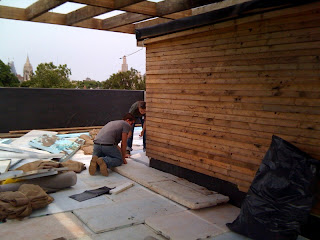
I would be remiss if I didn't add some imagery from the tail end of the Park Slope green roof install I worked on with EcoBrooklyn last week.
Unfortunately, I didn't get to see the end result since I had friends in town and couldn't help on the planting and last-minute touches. In any case, I've got some photos of drainage, soil, plants, personalities, and improv. supplies.
Hopefully at some point I'll get back on the roof and see how it all turned out. Come to think of it, though, I chatted with the neighbor while we were hoisting soil and she was very interested in having her roof greened. I'm going to head back on behalf of EcoBrooklyn next week and try to make her an offer she can't refuse, so perhaps I'll see the roof soon...
We had four 1.5 cu. yd. bags of Gaia Soil delievered and didn't have a crane, so Nash and I spent a full day bagging and lifting the soil onto the roof. It went off without a hitch, if you don't count my near-decapitation when the plywood/2x4 structure we used to protect the roof membrane fell three stories and landed next to my head.

Gennaro found some old drink racks and thought that they could double for these, to hold soil and plants in place on the sloped portion of the roof.
The perimeter and skylight boxes installed, ready for greenroof add-ons.

Drainage layer/water retention mat installed and ready for Gaia Soil. The layer we used is made by Colbond and incorporates a pretty impressive water retention mat. We dumped half of a 12 oz. bottle of seltzer on a 2-in. square sample and lost virtually none of it. Its drainage mesh is made from 40% post-industrial recycled polypropylene, to boot.
Unfortunately, I didn't get to see the end result since I had friends in town and couldn't help on the planting and last-minute touches. In any case, I've got some photos of drainage, soil, plants, personalities, and improv. supplies.
Hopefully at some point I'll get back on the roof and see how it all turned out. Come to think of it, though, I chatted with the neighbor while we were hoisting soil and she was very interested in having her roof greened. I'm going to head back on behalf of EcoBrooklyn next week and try to make her an offer she can't refuse, so perhaps I'll see the roof soon...
We had four 1.5 cu. yd. bags of Gaia Soil delievered and didn't have a crane, so Nash and I spent a full day bagging and lifting the soil onto the roof. It went off without a hitch, if you don't count my near-decapitation when the plywood/2x4 structure we used to protect the roof membrane fell three stories and landed next to my head.

Gennaro found some old drink racks and thought that they could double for these, to hold soil and plants in place on the sloped portion of the roof.

The perimeter and skylight boxes installed, ready for greenroof add-ons.

Drainage layer/water retention mat installed and ready for Gaia Soil. The layer we used is made by Colbond and incorporates a pretty impressive water retention mat. We dumped half of a 12 oz. bottle of seltzer on a 2-in. square sample and lost virtually none of it. Its drainage mesh is made from 40% post-industrial recycled polypropylene, to boot.

Nash is excited to plant. We got 20 lbs. of sedum clippings from Motherplants to encourage a mixture of species, rather than a monoculture plug-farm look.
Future Green Brownstone
I was poking around the net yesterday, searching for info. on greenroofs in NYC and Brooklyn and happened upon a series of posts on Brownstoner that I found totally fascinating. They're by a landscape architect/greenroofer named David Seiter who's got a firm in Brooklyn called Future Green Studio.
Apparently, Mr. Seiter was tapped to work on a greenroof for his co-op building in Park Slope, Brooklyn and decided to offer a glimpse into the development of the roof to the general public on Brownstoner. Check the site for some images of the Park Slope roof and some pretty neat images of other ideas/projects.
Apparently, Mr. Seiter was tapped to work on a greenroof for his co-op building in Park Slope, Brooklyn and decided to offer a glimpse into the development of the roof to the general public on Brownstoner. Check the site for some images of the Park Slope roof and some pretty neat images of other ideas/projects.
Tuesday, August 4, 2009
A video on the Vancouver Convention Center's green (living) roof
This video's pretty cool as long as you can stand the melodramatic soundtrack. Makes me think that my growing medium idea is totally reasonable... though lava might be less carbon intensive than calcined clay, depending on the sources.
Monday, July 13, 2009
Carroll Gardens garden roof
I've been researching green roofs for Eco Brooklyn for the better part of two months, and have become acquainted with the components and fluent in the language. I've really enjoyed learning the theory. But because of the confines my dayjob, I have been limited to developing an abstract notion and knowledge of The Green Roof. This weekend that finally changed, as I participated in my first green roof installation.
 Prepping the roof for the water retention layer: Jack cutting reclaimed styrofoam insulation to form the perimeter boundary.
 Gennaro inserting plugs of radiant heating tube to keep the roof from slipping downslope. The water retention layer was actually triple-ply filter fabric and it created slipping problems (this is NOT protocol: do not do this if you can avoid it).
 Plugs in place. Notice the (drilled out) drainage holes -- there are fewer upslope and additional ones as you approach the drain.
 Laying the filter fabric over the drainage layer: challenging when the wind is gusting.
 Gaia soil: good growing medium (made with compost and shredded styrofoam packing peanuts) used to fill the burlap bags laid on the roof.
 Burlap bags to be cut and planted with sedum...
 Sedum cuttings waiting to be planted.
 The (by far) least glamorous green roof job: pulling soggy, moldy year-old woodchips out and marching them up four flights to mulch the roof and keep moisture in.
 A sea of blank canvases waiting to be attended to.
We worked with folks from Green-It-Yourself (GIY) to install a modular extensive green roof using Gaia Soil, burlap bags and a variety of sedums. We ran into some unforeseen issues and couldn't finish while it was light on Saturday, so folks were going back today. I imagine that Gennaro will post photos of the finished roof on the Eco Brooklyn blog, so check there if you want to see the remainder of the project. In the meantime, check out my photos below (sorry the picture quality is kind of bad -- had to use the iPhone camera since I broke my digital in a rainstorm).
Get in touch if you want to learn how to do this yourself...
 Prepping the roof for the water retention layer: Jack cutting reclaimed styrofoam insulation to form the perimeter boundary.
 Gennaro inserting plugs of radiant heating tube to keep the roof from slipping downslope. The water retention layer was actually triple-ply filter fabric and it created slipping problems (this is NOT protocol: do not do this if you can avoid it).
 Plugs in place. Notice the (drilled out) drainage holes -- there are fewer upslope and additional ones as you approach the drain.
 Laying the filter fabric over the drainage layer: challenging when the wind is gusting.Gaia soil: good growing medium (made with compost and shredded styrofoam packing peanuts) used to fill the burlap bags laid on the roof.
 Burlap bags to be cut and planted with sedum...
 Sedum cuttings waiting to be planted.
 The (by far) least glamorous green roof job: pulling soggy, moldy year-old woodchips out and marching them up four flights to mulch the roof and keep moisture in.
 A sea of blank canvases waiting to be attended to.
Tuesday, July 7, 2009
Musings on urban blight
First, a photographer interested in documenting the Gowanus Canal, something that I had thought about doing before I realized he'd already done it. I don't have the evidence with me here on this computer, but the similarity in some of the pictures we've taken is kind of eerie.
Second, SF-based designers who want to make something of their city's empty lots. Kind of reminds me of my backyard garden.
Second, SF-based designers who want to make something of their city's empty lots. Kind of reminds me of my backyard garden.
Tuesday, June 2, 2009
What to consider when building a green roof
My first post on the Eco Brooklyn website focused on important elements to consider when installing a green roof. Here it is:
One strategy for addressing impacts associated with urban development is to reduce the functional area of developed surface. The European community, and especially Germany, has opted to do so by re-vegetating roofs. Green roofs have been associated with a variety of environmental and economic benefits, including the ability to retain precipitation, filter pollutants, reduce maximum rooftop temperatures, insulate buildings, and reduce the urban heat island effect. Interest in green roof development in the United States has recently spiked, and the industry continues to grow consistently.
Investigations into the effectiveness of green roofs, however, have shown that not all green roofs perform equally. In order to ensure that a green roof functions as desired, it is important that the designer considers several factors. These include:
- desired endpoint (e.g., is roof being constructed to provide habitat, buffer stormwater, beautify, etc.?);
- type of roof (e.g., whether an intensive roof — park-like, interactive, relatively high maintenance, and typically heavier — or extensive roof — non-interactive, low maintenance, lighter — is appropriate for the functions desired);
- whether structural modifications are necessary to handle additional weight associated with the green roof;
- overall composition of roof system (e.g., whether to include water retention mats, depth of substrate);
- proper substrate formula;
- which mix of vegetative species will grow well together and perform expected functions, and;
- time to maturity and establishment method for vegetation (obtaining sod-like pre-grown vegetation mats, planting on-site as plugs, or planting on-site as shoots).
In my next several posts, I will explore these questions and others as I identify methods for installing a green roof system for the Eco Brooklyn show house. I will review primary literature, information available from practitioners, and identify supply chains in the New York City area. The project will culminate with the installation of the roof.
I'm presently writing the first of a series of follow-ups focusing on the "guts" of the roof -- basically from insulation to water retention mat. In subsequent postings, I will investigate growing media and identify appropriate vegetation and strategies for ensuring that vegetation thrives.
We plan to install the roof within the next several months, and will post photos documenting the process when it's finished.
Tuesday, May 5, 2009
Rising Tides...
The American Society of Landscape Architects posted a blog entry today about a totally cool competition designed to stimulate discussion on how to address the challenges that rising sea levels present for infrastructure, the environment, and quality of life in San Francisco and elsewhere. The competition forces competitors to consider, for example, how to manage wetlands appropriately, how to anticipate changes to the shoreline (check out my earlier post re: an online tool for visualizing SLR under various scenarios), and how to retrofit structures and/or areas designed to be dry to withstand inundation. Check out the competition homepage here for more details.
Subscribe to:
Posts (Atom)


