A couple of tidbits for your Monday AM:
An interesting article about the symbiosis between greenroofs/white roofs and PV panels...
And a very cool building planned for Portland, OR.
And last, but not least, the Wall Street Journal did a short overview of stormwater management in big -- and biggish -- American cities.
Showing posts with label design. Show all posts
Showing posts with label design. Show all posts
Monday, July 12, 2010


Friday, July 9, 2010
Greenroofs in the news
Three interesting articles today:
1. NPR outlines the benefits of green- and cool roofs.
2. Another rooftop farm in NYC, started by one of the people that developed the one in Greenpoint.
3. Systems for making sure your greenroof doesn't leak.
1. NPR outlines the benefits of green- and cool roofs.
2. Another rooftop farm in NYC, started by one of the people that developed the one in Greenpoint.
3. Systems for making sure your greenroof doesn't leak.
Tuesday, July 6, 2010
Monday, June 21, 2010
Galactic gardening in NYC
No need to consider soil fertility with these hydroponic greenhouse pods. Very interesting... but they presumably offer no water retention or insulation...
Saturday, June 19, 2010
Rooftop soil fertility
A very interesting article on fertility problems associated with Uncommon Ground's intensive greenroof/garden roof soil.
Tuesday, May 18, 2010
Tuesday, May 11, 2010
Green roofs and walls
I've made a couple of cool discoveries over the past couple of days and wanted to share them.
First, in our quest to find the perfect wedding venue, my fiancee and I took to Durham, NC. While we didn't find a spot for vows, we did find a new parking garage at Duke -- complete with greenroofs and walls. A couple of photos, and a couple of links:


Here's some information and a few graphics that picture areas that I couldn't capture.
The garage follows tenets outlined in the New Campus Master Plan (essentially, the redevelopment of the old Central Campus).
Second, I got a note from a client yesterday with images of a greenroof we installed at the end of last summer (see below). So far, so good! The sedum should fill in the gaps this summer.


Last, but not least: Columbia and Con Ed have teamed to assess the insulating and cooling capacities of cool roofs (white roofs and greenroofs) vs. conventional black roofs (tar beaches!). In a very interesting study released last week, the group found that green and white roofs perform roughly equally in preventing heat island effect (through evapotranspiration and albedo, respectively) and that each limited temperature variability enough to produce modest energy savings. There is concern, however, that the performance of older white roofs may suffer since the reflectance of these roofs declines as they age. White roofs also lack the ability to moderate water flow, improve air and water quality, provide habitat and recreation space, and improve aesthetics for nearby neighbors, six of the primary motivators for greenroof installation. A very interesting study and I look forward to reading future research findings...
First, in our quest to find the perfect wedding venue, my fiancee and I took to Durham, NC. While we didn't find a spot for vows, we did find a new parking garage at Duke -- complete with greenroofs and walls. A couple of photos, and a couple of links:


Here's some information and a few graphics that picture areas that I couldn't capture.
The garage follows tenets outlined in the New Campus Master Plan (essentially, the redevelopment of the old Central Campus).
Second, I got a note from a client yesterday with images of a greenroof we installed at the end of last summer (see below). So far, so good! The sedum should fill in the gaps this summer.


Last, but not least: Columbia and Con Ed have teamed to assess the insulating and cooling capacities of cool roofs (white roofs and greenroofs) vs. conventional black roofs (tar beaches!). In a very interesting study released last week, the group found that green and white roofs perform roughly equally in preventing heat island effect (through evapotranspiration and albedo, respectively) and that each limited temperature variability enough to produce modest energy savings. There is concern, however, that the performance of older white roofs may suffer since the reflectance of these roofs declines as they age. White roofs also lack the ability to moderate water flow, improve air and water quality, provide habitat and recreation space, and improve aesthetics for nearby neighbors, six of the primary motivators for greenroof installation. A very interesting study and I look forward to reading future research findings...
Tuesday, April 27, 2010
Chicago's Comer Youth Center green roof wins ASLA award
I've got this fantasy about starting a network of agriculture-supporting green roofs, akin to the one at Rooftop Farms in Brooklyn. Seems as though I'm onto something. Much more here.
Wednesday, April 14, 2010
Greenroofs for Redstarts
In another success story for urban wildlife, green roof professionals in Sheffield, England have replicated habitat favored by the Black Redstart to the degree that the birds now appear to inhabit the roofs.
Also, there's an audio slideshow of a "greenroof safari" here. The narration explains some of the benefits of green roofs and depicts a variety of those found in Sheffield (actually, the show provides a good sense of the different intents and designs associated with greenroofs, from recreation areas to those made to mimic habitat). Our intrepid narrator gets inexplicably and disconcertingly winded at the end... perhaps an issue with heights?
Also, there's an audio slideshow of a "greenroof safari" here. The narration explains some of the benefits of green roofs and depicts a variety of those found in Sheffield (actually, the show provides a good sense of the different intents and designs associated with greenroofs, from recreation areas to those made to mimic habitat). Our intrepid narrator gets inexplicably and disconcertingly winded at the end... perhaps an issue with heights?
Wednesday, March 24, 2010
In Brooklyn, Lettuce, Not Steel, Scrapes the Sky
Today the Atlantic published an inspiring piece by Annie Novak of Rooftop Farms. Check it out: In Brooklyn, Lettuce, Not Steel, Scrapes the Sky.
Friday, September 18, 2009
Building a cold frame
Perhaps not strictly water-related, but very well done and awesome for us gardeners mourning summer. I'm embarking on my cold frame adventure tomorrow.
How to Build a Cold Frame - Funny video clips are a click away
How to Build a Cold Frame - Funny video clips are a click away
Monday, September 14, 2009
Rooftop Farms
So, I finally made it to Rooftop Farms in Greenpoint yesterday to scope out what they're up to and how they've managed to grow vegetables and fruits atop the City That Never Sleeps. I must say, it's a great space albeit smaller than I had envisioned.
They had what looked to be a decent year despite the bad weather. Lots of healthy looking tomatoes, chard, kale, cilantro, lettuce, winter squash, beans, eggplants, peppers, etc.
Unfortunately, I wasn't able to get details on the technical considerations, since apparently Goode Green did the design and installation of the greenroof without involving the farmers themselves.
Nevertheless, I got some cool shots on my phone and will return (next week, assuming I get all my fall seeds planted on Friday or Saturday) to help and -- hopefully -- learn something about composting sans worms.
They had what looked to be a decent year despite the bad weather. Lots of healthy looking tomatoes, chard, kale, cilantro, lettuce, winter squash, beans, eggplants, peppers, etc.
Unfortunately, I wasn't able to get details on the technical considerations, since apparently Goode Green did the design and installation of the greenroof without involving the farmers themselves.
Nevertheless, I got some cool shots on my phone and will return (next week, assuming I get all my fall seeds planted on Friday or Saturday) to help and -- hopefully -- learn something about composting sans worms.
 An unassuming building topped by a very cool roof.


Thursday, September 10, 2009
Vegetable roof
Check out this awesome flickr set of a friend's friend's very verdant rooftop garden in Chicago. Some great ideas and some really beautiful produce.
full sun + great air circulation + exceedingly inventive methods for keeping plants from getting thirsty = spectacular results
Once I get a rooftop that I can use, I will be referring to these pages again...

full sun + great air circulation + exceedingly inventive methods for keeping plants from getting thirsty = spectacular results
Once I get a rooftop that I can use, I will be referring to these pages again...

Tuesday, September 8, 2009
Brooklyn's Alps
An interesting story in yesterday's NY Times about rehabilitating a couple of dump sites in Brooklyn.
As someone who's done research on the problems that roots can pose in terms of maintaining a waterproof layer, I wonder what kind of reconnaisance the City has planned to make sure that the plastic sheeting isn't breached by roots...
As someone who's done research on the problems that roots can pose in terms of maintaining a waterproof layer, I wonder what kind of reconnaisance the City has planned to make sure that the plastic sheeting isn't breached by roots...
Thursday, September 3, 2009
Future Green Brownstone
I was poking around the net yesterday, searching for info. on greenroofs in NYC and Brooklyn and happened upon a series of posts on Brownstoner that I found totally fascinating. They're by a landscape architect/greenroofer named David Seiter who's got a firm in Brooklyn called Future Green Studio.
Apparently, Mr. Seiter was tapped to work on a greenroof for his co-op building in Park Slope, Brooklyn and decided to offer a glimpse into the development of the roof to the general public on Brownstoner. Check the site for some images of the Park Slope roof and some pretty neat images of other ideas/projects.
Apparently, Mr. Seiter was tapped to work on a greenroof for his co-op building in Park Slope, Brooklyn and decided to offer a glimpse into the development of the roof to the general public on Brownstoner. Check the site for some images of the Park Slope roof and some pretty neat images of other ideas/projects.
Tuesday, August 4, 2009
A video on the Vancouver Convention Center's green (living) roof
This video's pretty cool as long as you can stand the melodramatic soundtrack. Makes me think that my growing medium idea is totally reasonable... though lava might be less carbon intensive than calcined clay, depending on the sources.
Friday, July 31, 2009
Making green roof substrate
Just posted an entry to ecobrooklyn.com on making green roof substrate ourselves, rather than paying for commercial blends. Check it out here or below.
Green roofs use an engineered substrate, rather than natural soil, to support plant growth. There are a number of commercial varieties available, but these are often shipped considerable distances from supplier to consumer and can be expensive. To reduce the cost of our roofs, it would be best if we could produce our own green roof soil. In this post I will examine information available from a variety of roof soil producers and independent studies to explore the feasibility of making our own green roof substrate. (n.b. Substrate formula differs based on the type of roof being installed (i.e. extensive vs. intensive); since Eco Brooklyn focuses mainly on extensive roofs, I will concentrate on soil formulas for extensive roofs only.)
The planting substrate used in a green roof installation is crucial to the success and longevity of the roof itself. If the soil mixture does not support plant growth while simultaneoulsy allowing the roof to function as a traditional roof would (i.e. shedding water), then the installation will fail. Therefore, the standards to which green roof soil will be held are extremely high, and we need to do our best to get the formula right!
Steve Skinner, a green roof products manager with American Hydrotech and soil scientist, writes that the most important green roof substrate considerations include:
• grain size distribution
• density
• water & air management
• pH, lime & salt content
• organics
• nutrients
• cation exchange capacity (CEC)
Since the modern green roof movement began in Germany, the Germans have a head-start on establishing standards for successful green roofs. The FLL is held as the authority on green roof planning, execution, and upkeep, and has established guidelines for individual components, including substrate; these guidelines can be downloaded here.
Before we dive into FLL guidelines, let's check out some of the commercial soils and identify relevant attributes.
In our most recent green roof installation, we used Gaia Soil for Green Roofs, a locally-produced, lightweight (10 lbs./cu. ft. dry, 30 lbs./cu. ft. saturated) substrate made from expanded polystyrene (modified to improve water-holding and cation-exchange capacities), clay, and finshed compost. We liked that it was made close to New York City, that it was light, that it retained water well (200% of dry weight!), and that it uses recycled content. However, the soil was expensive and tricky to pick up and transport.
The makers of Live Roof, a modular green roof system, have developed their own brand of green roof substrate which aims to increase soil lifespan and reduce substrate shrinkage by incorporating a high percentage of inorganic material (94+%) and avoiding the use of peat moss, compost, and perlite, all of which can break down and erode after exposure to the elements. In addition, the system uses clay to bind nutrients, a buffering agent to reduce the impact of acid rain, and a disease-supressing organic element.
G-Sky produces two blends of Roof Soil from pumice, well graded sand, and aged bark mulch compost. The manufacturers claim that, given appropriate installation, these soils can be used with little or no structural support on roof slopes of up to 35 degrees.
Rooflite Extensive MC uses a blend of mineral lightweight aggregates like HydRocks, a calcined clay, and organic components to achieve FLL certification. Detailed specifications for the product can be found here.
The most important commonality among these substrates is that they include a high percentage of low-density inorganic particles. These elements, whether pectin-coated expanded polystyrene, pumice, or calcined clay, play an important role in air and water management: they allow the soil to drain quickly during heavy rains and, because they do not break down, maintain interstitial space over the long-term. Each blend also incorporates an organic element to absorb water and provide a nutrient reservoir. The organic component within roof soils, however, typically represents a lower proportion of the soil mass than would be found in a natural system and CEC (and nutrient availability) suffers as a result. Some companies, therefore, use calcined clay or add clay to their soils to increase CEC and bind essential plant nutrients like potassium, calcium, magnesium, and ammonium.
Independent studies are a good source for information on substrate formula, as well.
A recent Michigan State University study looked at the ability of a variety of substrates to support Sedum and native plant growth on rooftops in Michigan. In their study, Rowe et al. found that at a depth of 10 cm., a soil mixture of 80% heat-expanded slate (PermaTill, from Carolina Stalite), plus USGA grade sand, aged compost, and peat, amended by approximately 50 grams of controlled-release fertilizer per sq. m per year enabled a Sedum community to establish itself (in about a year) and thrive with minimal decomposition of organic material and nutrient-laden runoff.
Another study by Oberndorfer et al. suggests that organic components typically comprise about 10% (by weight) of green roof substrate and notes that crushed brick can be substituted for expanded (calcined) clay, depending on the load-bearing capacity of the roof.
In his 2007 dissertation for Ohio State University's Horticulture and Crop Science program, Reid Coffman notes that that extensive green roof soil is typically engineered to be 75% inorganic and 25% organic and closely mimics the conditions found within the rock outcrop ecosystem. In a 2006 article, Lundholm notes that the most popular plants used in green roofs are naturally found in these outcrop systems. Though I will not do so in this post, study of productive rock outcrop ecosystem soil may provide additional insight into optimal green roof substrate composition.
Lastly, Skinner's article provides very helpful information on green roof substrate composition. He notes that extensive green roof soils are typically between 3% and 6% organic by mass, but that additional organic matter can be added initially to help to establish young plants. The organic component, however, should have a low carbon to nitrogen ratio (i.e. be highly decomposed) so that plants can easily extract nutrients and to prevent the severe shrinkage and accumulation of toxic compounds that can accompany rapid decomposition. Humus made from composted straw, sawdust, wood, leaves, grass clippings, agricultural waste, biosolids, and/or animal carcasses, separately or in combination, could be used as the organic component in green roof media and will initialy provide the macro- and micronutrients necessary for plant growth, though later it may be necessary to amend the soil with fertilizer. The inorganic component, Skinner states, could be comprised of synthetic expanded slate, clay, or shale or of natural materials like pumice. Sand, perlite, scoria, or pumice fines are often used as secondary inorganic components. Skinner advises that soil pH be maintained between 6 and 7.5 and that the substrate contain carbonate levels sufficient for plants to readily absorb nutrients and water (though architect Allan Wingfield suggests that carbonate levels be kept in check since high levels (above 6 grams/liter) can lead to corrosion of roof drains and outlet pipes).
Based on the general formulas outlined here, it seems reasonable for us to develop our own Eco Brooklyn substrate blend for our extensive roof installations. The next step would be to source materials, mix a trial batch and, if we choose to try to meet FLL guidelines, perform an empirical comparison to the FLL figures. For example, FLL places emphasis on grain size, organic content, permeability, water storage, air content, pH, and salt and nutrient content, and all of these parameters must be within a specific range for the soil to be certified FLL compliant. Most of these characteristics could be easily measured, and our formula tweaked to ensure compatibility with the FLL guide.
Without undertaking an effort to guarantee FLL certification, however, I believe that it is possible to mix a good quality green roof substrate. To begin, I would advocate the use of calcined clay or expanded slate as our primary inorganic substance, as both have reasonably high CEC. Pumice, repurposed polystyrene, and lava rock (with some clay mixed in) would work as well, and might lower the embodied energy of our substrate mix (although calcined clay is produced as a byproduct of cement production in Brazil). Depending on the load-bearing capacity of the roof, crushed brick could be added to the mix, too. Cost will be a major factor in determining our ultimate formula. To the clay/slate/etc., I would recommend adding well graded sand and finished compost or humus. I would aim for 10% organic material initially, with the expectation that the percentage will fall to closer to 5%. I would plan to amend the substrate with fertilizer annually, and water the roof if it has not received precipitation for two weeks.
In an ideal world, we would work to get our soil to FLL spec, and periodically test the product to ensure that it is appropriately mixed. For now, however, the time that it would take to test and reformulate the soil is not a luxury that we have. Still, based on my analysis of the green roof studies and substrate formulas available, I feel reasonably confident that my recommendations will produce a soil that will green a roof and support plant growth for years to come.
Thursday, July 30, 2009
White light/white heat
The New York Times featured a story today on the energy benefits of white roofs. The article speaks to the savings that white roofs produce in hot climates, while acknowledging that they are not a panacea; in cities like Minneapolis and Detroit, scientists suggest that white roofs can actually lead to increased energy bills since they reflect light (and heat) during cold winter months.
While I can't refute evidence on the suitability of white roofs in northern climes, I certainly can speak to the benefit of green roofs. The beauty of the green roof is that it buffers temperature extremes, whether hot or cold. If you're skeptical, plug "green roof energy savings" into Google Scholar and see what comes up. (Start with these: "Analysis of the green roof thermal properties and investigation of its energy performance" by Niachou et al. and "The effects of rooftop garden on energy consumption of a commercial building in Singapore" by Wong et al.).
I'm not sure why the author didn't think it appropriate to include green roof information in the article, but I sure wish that there were a comment section on this one...
While I can't refute evidence on the suitability of white roofs in northern climes, I certainly can speak to the benefit of green roofs. The beauty of the green roof is that it buffers temperature extremes, whether hot or cold. If you're skeptical, plug "green roof energy savings" into Google Scholar and see what comes up. (Start with these: "Analysis of the green roof thermal properties and investigation of its energy performance" by Niachou et al. and "The effects of rooftop garden on energy consumption of a commercial building in Singapore" by Wong et al.).
I'm not sure why the author didn't think it appropriate to include green roof information in the article, but I sure wish that there were a comment section on this one...
Monday, July 13, 2009
Carroll Gardens garden roof
I've been researching green roofs for Eco Brooklyn for the better part of two months, and have become acquainted with the components and fluent in the language. I've really enjoyed learning the theory. But because of the confines my dayjob, I have been limited to developing an abstract notion and knowledge of The Green Roof. This weekend that finally changed, as I participated in my first green roof installation.
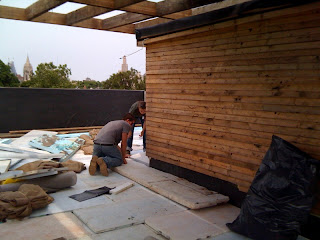 Prepping the roof for the water retention layer: Jack cutting reclaimed styrofoam insulation to form the perimeter boundary.
 Gennaro inserting plugs of radiant heating tube to keep the roof from slipping downslope. The water retention layer was actually triple-ply filter fabric and it created slipping problems (this is NOT protocol: do not do this if you can avoid it).
 Plugs in place. Notice the (drilled out) drainage holes -- there are fewer upslope and additional ones as you approach the drain.
 Laying the filter fabric over the drainage layer: challenging when the wind is gusting.
 Gaia soil: good growing medium (made with compost and shredded styrofoam packing peanuts) used to fill the burlap bags laid on the roof.
 Burlap bags to be cut and planted with sedum...
 Sedum cuttings waiting to be planted.
 The (by far) least glamorous green roof job: pulling soggy, moldy year-old woodchips out and marching them up four flights to mulch the roof and keep moisture in.
 A sea of blank canvases waiting to be attended to.
We worked with folks from Green-It-Yourself (GIY) to install a modular extensive green roof using Gaia Soil, burlap bags and a variety of sedums. We ran into some unforeseen issues and couldn't finish while it was light on Saturday, so folks were going back today. I imagine that Gennaro will post photos of the finished roof on the Eco Brooklyn blog, so check there if you want to see the remainder of the project. In the meantime, check out my photos below (sorry the picture quality is kind of bad -- had to use the iPhone camera since I broke my digital in a rainstorm).
Get in touch if you want to learn how to do this yourself...
 Prepping the roof for the water retention layer: Jack cutting reclaimed styrofoam insulation to form the perimeter boundary.
 Gennaro inserting plugs of radiant heating tube to keep the roof from slipping downslope. The water retention layer was actually triple-ply filter fabric and it created slipping problems (this is NOT protocol: do not do this if you can avoid it).
  Plugs in place. Notice the (drilled out) drainage holes -- there are fewer upslope and additional ones as you approach the drain.
 Laying the filter fabric over the drainage layer: challenging when the wind is gusting.Gaia soil: good growing medium (made with compost and shredded styrofoam packing peanuts) used to fill the burlap bags laid on the roof.
 Burlap bags to be cut and planted with sedum...
 Sedum cuttings waiting to be planted.
 The (by far) least glamorous green roof job: pulling soggy, moldy year-old woodchips out and marching them up four flights to mulch the roof and keep moisture in.
 A sea of blank canvases waiting to be attended to.
Thursday, July 9, 2009
Green roofs on a slope
I posted another note on the Eco Brooklyn webpage this evening, this time about installing green roofs on a pitched slope. Here it is:
In this post, I’m going to diverge from the format of my past several entries a bit and explore strategies for installing green roofs on pitched surfaces.
The International Green Roof Association (IGRA) states that roofs with up to a 30 degree pitch can be outfitted with a green roof, and that “traditional” green roof components can generally be safely and effectively used on roof slopes up to 10 degrees. Beyond the 10 degree threshold, however, installation becomes significantly different from a traditional green roof and requires a different approach.
Though some problems typically associated with green roofs can be mitigated when installing on a sloped suface (e.g., drainage is better and water does not typically pool as frequently), other stressors arise. Modifications to structural components, growth medium, and vegetation must be made to prevent roof failure. I will explore challenges and techniques for installing green roofs on sloped roofs in more detail below.
To start, the IGRA wrote a brief but helpful introduction to pitched green roofs (scroll to the bottom of page 2). The article points out several important challenges to establishing a vegetative community on a pitched roof. First, shear forces threaten to pull the build-up, substrate, and plants off of the roof. Second, the substrate is more highly susceptible to erosion. Third, plants are often subjected to more intensive drought stress.
Other sources, including a Zinco planning guide, highlight some of the other important challenges to establishing sloped green roofs. For example, pitched roofs with southern exposure are typically subjected to more intense solar radiation than flat roofs, which can dessicate plants more rapidly. In addition, installing independent root barriers is often difficult or impossible since build-up materials may slip more easily against root barrier materials than against waterproofing membranes, so waterproofing membranes must be root-proof. Third, access for routine maintenance on sloped roofs is more difficult, but must be incorporated into the design. Lastly, to prevent erosion, vegetation must be planted and cultivated to cover the roof as quickly as possible, and coverage must remain high year-round. And as roof slope increases, these challenges typically become more severe.
Although establishing a pitched green roof can be more challenging than installing a flat roof, steps can be taken to ensure that a sloped green roof functions as desired. allbusiness.com and the Pomegranate Center provide good perspective on establishing sloped green roofs in an article and a homeowners’ guide, respectively, that I borrow from below.
First, a varety of structural and build-up components can be installed to hold the roof in place. Safeguard produced a good visual how-to on installing pitched green roofs; it includes information on installing front edging boards and free-standing timber frames and can be found here. Green roof component producers make build-up materials specifically for use in pitched roof situations, as well. For example, Zinco’s Floraset FS 75 and Georaster provide additional reinforcement to the substrate layer, thereby reducing erosion. Designers of one of the steepest green roofs in North America used Roofscapes, Inc.’s Roofmeadow Type I, a full green roof system intended for pitched roofs, which includes an integrated “slope stabilization system”, in their build-up. American Hydrotech produces GardNet, and Presto Products Corp. produces Geoweb, components that divide the roof into cells and thereby help to reduce erosion on sloped roofs. Colbond makes Enkamat, a 3-D mat designed to act as a synthetic root structure and quickly and permanently prevent soil erosion. In lower-slope applications, jute, straw, or wood erosion mats laid top the substrate might suffice to reduce soil movement and loss.
Second, design of nonproprietary components (e.g., growth media, plant type, etc.) can be modified to address concerns associated with pitched green roofs. Growth media depth can be increased (depending upon the roof’s load bearing capacity) to retain additional moisture, or irrigation can be built into the roof design for use in serious droughts. Growth media formula can be tweaked to ensure greater water retention. Thicker water retention mats can be used to retain additional moisture, as well. Vegetation must be chosen carefully to ensure that the plant community grows quickly enough to cover the roof withtin the first growing season and survives prolonged periods without water. In addition, it is important to consider that water will flow down the roof, affording rooftop plants the least amount of time to absorb water and those plants along the bottom edges of the roof more time. In some cases, it may be beneficial to increase growth medium depth at the rooftop to allow additional water storage. It might also be beneficial to plant vegetation that can tolerate drier conditions on roof peaks and vegetation that grows best in wetter conditions along the gutters.
The bottom line, therefore, is that with careful planning it is possible to sucessfully install a pitched green roof. It is crucial, however, that builders make considerate design choices and source appropriate materials.
The next steps in outlining a design for a pitched green roof include identifying which particular materials will be used to build the roof, identifying appropriate growth media composition and depth, and choosing vegetation. Part of the decision-making process with respect to build-up components will depend upon cost and availability. Build-up components will, to an extent, influence nonproprietary components. Getting prices and information on whether these materials can be shipped to Brooklyn, then, is the next priority. This process can sometimes be tricky, however, as green roof materials (and their prices) are generally available only through company sales representatives. I’ve begun contacting folks at the companies I’ve listed above to get a feel for what these products will cost and will post that information when it becomes available. Check back!
In this post, I’m going to diverge from the format of my past several entries a bit and explore strategies for installing green roofs on pitched surfaces.
The International Green Roof Association (IGRA) states that roofs with up to a 30 degree pitch can be outfitted with a green roof, and that “traditional” green roof components can generally be safely and effectively used on roof slopes up to 10 degrees. Beyond the 10 degree threshold, however, installation becomes significantly different from a traditional green roof and requires a different approach.
Though some problems typically associated with green roofs can be mitigated when installing on a sloped suface (e.g., drainage is better and water does not typically pool as frequently), other stressors arise. Modifications to structural components, growth medium, and vegetation must be made to prevent roof failure. I will explore challenges and techniques for installing green roofs on sloped roofs in more detail below.
To start, the IGRA wrote a brief but helpful introduction to pitched green roofs (scroll to the bottom of page 2). The article points out several important challenges to establishing a vegetative community on a pitched roof. First, shear forces threaten to pull the build-up, substrate, and plants off of the roof. Second, the substrate is more highly susceptible to erosion. Third, plants are often subjected to more intensive drought stress.
Other sources, including a Zinco planning guide, highlight some of the other important challenges to establishing sloped green roofs. For example, pitched roofs with southern exposure are typically subjected to more intense solar radiation than flat roofs, which can dessicate plants more rapidly. In addition, installing independent root barriers is often difficult or impossible since build-up materials may slip more easily against root barrier materials than against waterproofing membranes, so waterproofing membranes must be root-proof. Third, access for routine maintenance on sloped roofs is more difficult, but must be incorporated into the design. Lastly, to prevent erosion, vegetation must be planted and cultivated to cover the roof as quickly as possible, and coverage must remain high year-round. And as roof slope increases, these challenges typically become more severe.
Although establishing a pitched green roof can be more challenging than installing a flat roof, steps can be taken to ensure that a sloped green roof functions as desired. allbusiness.com and the Pomegranate Center provide good perspective on establishing sloped green roofs in an article and a homeowners’ guide, respectively, that I borrow from below.
First, a varety of structural and build-up components can be installed to hold the roof in place. Safeguard produced a good visual how-to on installing pitched green roofs; it includes information on installing front edging boards and free-standing timber frames and can be found here. Green roof component producers make build-up materials specifically for use in pitched roof situations, as well. For example, Zinco’s Floraset FS 75 and Georaster provide additional reinforcement to the substrate layer, thereby reducing erosion. Designers of one of the steepest green roofs in North America used Roofscapes, Inc.’s Roofmeadow Type I, a full green roof system intended for pitched roofs, which includes an integrated “slope stabilization system”, in their build-up. American Hydrotech produces GardNet, and Presto Products Corp. produces Geoweb, components that divide the roof into cells and thereby help to reduce erosion on sloped roofs. Colbond makes Enkamat, a 3-D mat designed to act as a synthetic root structure and quickly and permanently prevent soil erosion. In lower-slope applications, jute, straw, or wood erosion mats laid top the substrate might suffice to reduce soil movement and loss.
Second, design of nonproprietary components (e.g., growth media, plant type, etc.) can be modified to address concerns associated with pitched green roofs. Growth media depth can be increased (depending upon the roof’s load bearing capacity) to retain additional moisture, or irrigation can be built into the roof design for use in serious droughts. Growth media formula can be tweaked to ensure greater water retention. Thicker water retention mats can be used to retain additional moisture, as well. Vegetation must be chosen carefully to ensure that the plant community grows quickly enough to cover the roof withtin the first growing season and survives prolonged periods without water. In addition, it is important to consider that water will flow down the roof, affording rooftop plants the least amount of time to absorb water and those plants along the bottom edges of the roof more time. In some cases, it may be beneficial to increase growth medium depth at the rooftop to allow additional water storage. It might also be beneficial to plant vegetation that can tolerate drier conditions on roof peaks and vegetation that grows best in wetter conditions along the gutters.
The bottom line, therefore, is that with careful planning it is possible to sucessfully install a pitched green roof. It is crucial, however, that builders make considerate design choices and source appropriate materials.
The next steps in outlining a design for a pitched green roof include identifying which particular materials will be used to build the roof, identifying appropriate growth media composition and depth, and choosing vegetation. Part of the decision-making process with respect to build-up components will depend upon cost and availability. Build-up components will, to an extent, influence nonproprietary components. Getting prices and information on whether these materials can be shipped to Brooklyn, then, is the next priority. This process can sometimes be tricky, however, as green roof materials (and their prices) are generally available only through company sales representatives. I’ve begun contacting folks at the companies I’ve listed above to get a feel for what these products will cost and will post that information when it becomes available. Check back!
Subscribe to:
Posts (Atom)
